
When Hope Became Reasonable: The Bears, Chicago, and a Season That Changed Expectations
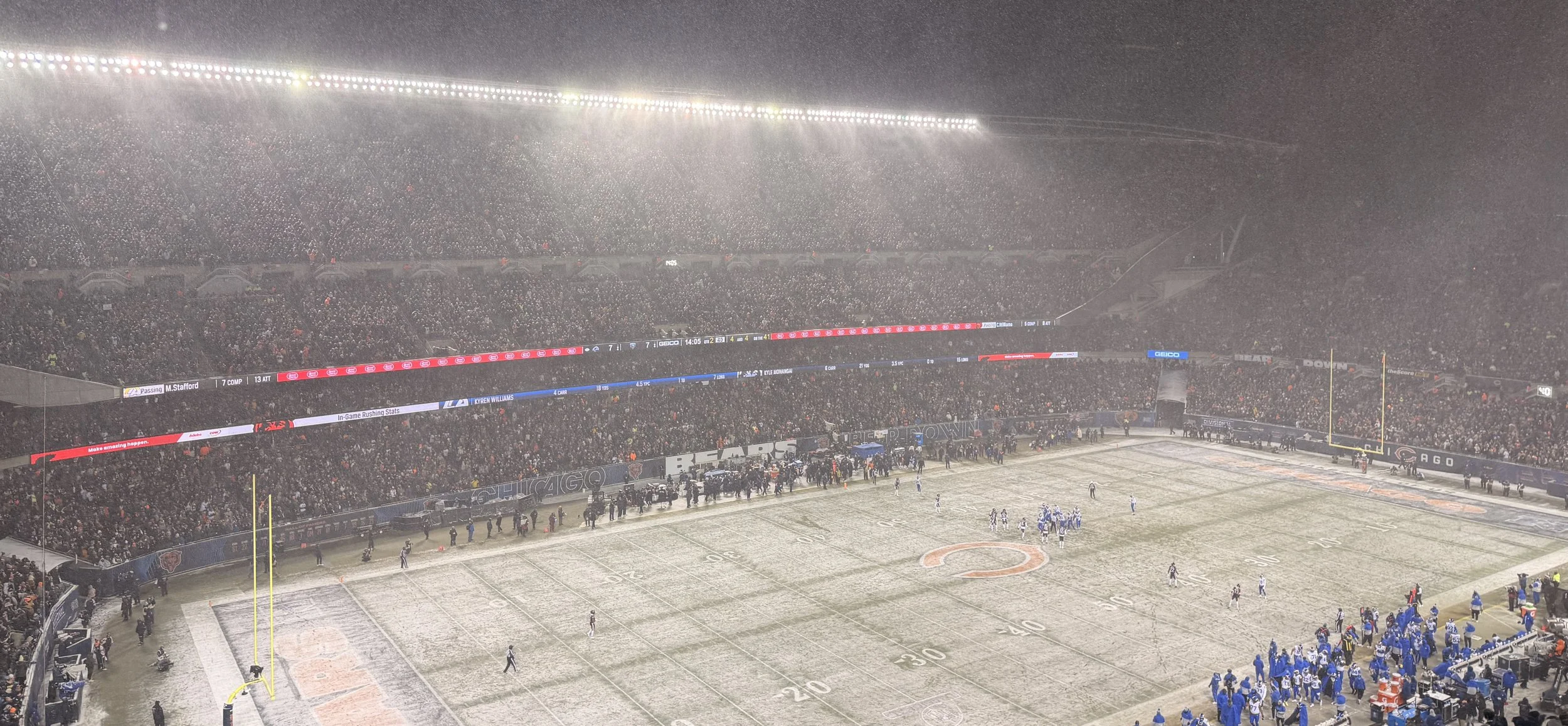
There are 32 teams in the NFL, and I’m sure they all mean a lot (I think?) to the cities and regions they inhabit. But in Chicago? The Bears are different. They’re not just a franchise or a brand; they’re a cultural standard, a way of life, a near-religion passed down the way accents and loyalties are. This is a team that stands far and above any other team in this city. Always have. While the Bulls gave us a dynasty, the Blackhawks gave us parades and the Sox and Cubs split the city like an old family argument that never quite heals, the Bears gave Chicago something deeper; a shared identity. North Side, South Side, West Side, city, suburbs, blue collar, white collar, believer and skeptic alike. When the Bears matter, the city of Chicago moves together. You can be wearing black and gold, blue and red, be a Catholic school or CPS kid, none of it matters on Sunday.
To be a fan, it doesn’t matter which neighborhood you’re from or who your people are. Hell, you can even be one of those people outside the city limits who swear they’re “from Chicago,” on Sunday, none of that matters. Because on Sunday, we’re all family, drawn together by a team that shows up like winter, like grief, like hope: unavoidable, inescapable, and shared. For the first time in a long while, the city felt something we’d almost learned to stop expecting: hope. Not an NFC title. Not a Super Bowl parade. Just hope. The dangerous kind of hope. The kind that gets you invested again. The kind that has you proudly claiming your fandom instead of bracing for the usual response of “You’re a Bears fan?!” It’s the kind of hope that sees outsiders look around and ask, “Wait… the Bears are good?” It’s an intoxicating feeling, a kind of high that’s hard to put into words. And sure, some will respond with, “It’s just sports.” But anyone who says that has never watched this city believe together.
Of course, Bears fans have been here before, albeit infrequently. The problem is that while hope is not new in Chicago, it usually does not last. We’ve learned to carry it carefully, like something fragile that breaks the moment you start trusting it. For decades, being a Bears fan has meant mistaking flashes for foundations: a good defense without an offense, a quarterback who’s “close,” a season that starts with promise and ends with familiar frustration in the postseason; whether it be a 4th and 8 defensive lapse or a doink that shakes the very foundations of the city. It’s these heartbreaks and frustrations that have slowly turned loyalty into mostly muscle memory. You showed up on Sundays not because you expected something good to happen, but because showing up is what you do as a Bears fan. The cynicism that came with it wasn’t a lack of faith, it was self-preservation. You tell yourself not to get your hopes up to spare your feelings and prevent that inevitable burnout that happens after a lackluster season.
But the 2025–26 season didn’t feel like one of those false starts. There wasn’t an avalanche of offseason hype or the annual tradition of convincing ourselves that “this time was different.” Instead, it felt like Bears fans collectively crossed their arms and decided, earn it.
The first winless weeks of the season felt familiar and disappointing. That part we were very familiar with, but as the weeks went on, the Bears began to look like something unexpected— competent, and at times even confident. When they jumped out to a big lead against Cincinnati and then promptly lost it, most fans braced for the collapse. That’s how this usually goes. But instead, something stirred that had been dormant for a long time. They fought back. They clawed back. And their quarterback willed them to a win. For many of us, that kind of response was uncharted territory, producing feelings that haven’t been normal around here.
Suddenly, you looked up and the Bears had beaten the defending champs and were sitting in prime position for a divisional title. Many of the wins required late-game heroics, but they showed an ability to adapt instead of simply survive. Come-from-behind wins didn’t feel accidental and even when things went wrong, the team responded instead of collapsing and for a fan base conditioned to expect the worst, that alone felt radical. My favorite example of this was week 14 in Green Bay. The Bears lost to the Packers, 28–21, and for years that result would’ve felt like the same old story, but this time was different. Walking out of Lambeau, there was real confidence that the Bears would get their revenge. And boy, did they.
What made this season different wasn’t just the record or the standings, it was the sense that the floor had been raised, and this didn’t feel like a team borrowing success; it felt like a team building toward something. There was structure. There was patience. There was a sense that the people in charge knew what they were doing, and that alone restored a kind of trust Bears fans had quietly given up on. For the first time in a long time, hope didn’t feel like denial. It felt reasonable.
The entirety of this shift can’t be attributed to any one person, but if you’re tracing its clearest lines, they lead to two names: Ben Johnson and Caleb Williams. Johnson had long been an obstacle for the Bears, building a prolific offense as the offensive coordinator of the Detroit Lions; one that could beat you through the air or on the ground without apology. So, when word broke that he would be the next head coach in Chicago, a quiet joy rippled through the city, fueled by the hope that the Bears might finally have a consistent, modern offense. His arrival wasn’t just the introduction of a new playbook; it marked the beginning of a new standard. For the first time in a long time, the Bears felt like a professionally run football team from the top down. As the improvements became evident, anticipation grew and not just for wins, but for what followed them. The Bears began to form a tradition tied to winning, best captured in Ben Johnson’s now-infamous “Good, Better, Best” chant. Simple in form and learned long before his time in Chicago, it became a reflection of the standard he was building. It spread from the locker room to the fan base, reinforcing the belief that there was more to this team and that this wasn’t the “Same Ol Bears.” That culture shift was obvious early, and it gave the fan base permission to believe this wasn’t another temporary high, but the beginning of something sustainable.
And then there was Caleb Williams. By the end of the season, Bears fans weren’t just hopeful about him. They trusted him. They believed him. And when the game seemed out of reach, they held faith that the offense would rally around him to find a way. He earned the nickname “Iceman” not because he was flashy, but because he was unbothered. Late-game drives didn’t feel frantic. Big moments didn’t speed him up. Records quietly fell as he rewrote what quarterback play could look like in Chicago, breaking passing marks that had stood untouched for decades. More importantly, he showed up when it mattered most. Nowhere was that clearer than against That Team Up North (I’m a Buckeye fan, I can use this) aka the Green Bay Packers. His late game touchdown to DJ Moore (x2) didn’t just win a game, they flipped a script that’s haunted this city for decades. These throws weren’t simple luck but they were statements to the division and league; they were statements. By season’s end, it no longer felt premature to say it out loud: Caleb Williams was already one of the best quarterbacks the Chicago Bears have ever had. Not because of potential, but because of what he had already done. He didn’t just give Bears fans hope—he justified it.
All of this is good. Necessary, even. But with hope comes expectation, and expectation changes the terms of this relationship. A playoff win matters (especially around here) but it can’t be the destination. Not anymore. Not with this coach, this quarterback, and this standard. What Ben Johnson and Caleb Williams helped restore needs to be followed up with ambition. And ambition doesn’t settle for being happy to be invited. The bar has been raised, whether we like it or not and progress is no longer measured by respectability or moral victories but by results when the games matter most. And to be honest, this is the shift Bears fans have been asking for, even if it comes with anxiety after. That doesn’t mean parades or championships are guaranteed. It means the goal is finally clear for all; the measure of success for the Chicago Bears can no longer be simple “good” It has to be better. It has to be the best (That was corny, I know). The Bears need: sustained success, January relevance and a team that doesn’t just give the city something to believe in, but something to expect. That kind of expectation is heavier, and it comes with pressure but it’s also a gift. Because for the first time in a long time, Bears fans aren’t just hoping this is real, they’re preparing for what comes next. And that might be the surest sign of all that something has truly changed.